There are afternoons in Glasgow when the air itself feels charged — when history presses down from the stands and every blade of grass seems to carry the weight of generations. This is not merely about ninety minutes. It is about pride forged in fire, about identity stitched into scarves, about families divided by colour yet united by the same restless heartbeat. In this city, tradition does not whisper — it roars.
For supporters of Rangers and Celtic, the Old Firm is a ritual, an inheritance, and a test of nerve. It is a clash shaped by resilience and defiance, by decades of triumph and trauma. When these two institutions collide, composure dissolves and legacies tremble. Sunday at Ibrox Stadium was no exception — it was theatre, turbulence, and controversy compressed into one unforgettable spectacle.
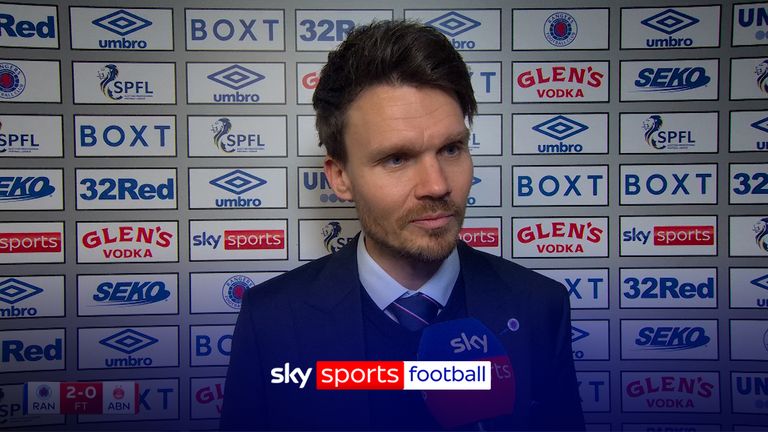
And at the centre of it all stood Danny Röhl, refusing to bow, refusing to concede the narrative, even as a 2–0 lead slipped agonisingly from his grasp.
Rangers looked imperious early on. Youssef Chermiti’s breathtaking overhead strike after eight minutes ignited the stadium, a finish that felt symbolic — bold, fearless, emphatic. The second goal, carved from Celtic uncertainty, exposed defensive hesitation as Chermiti pounced with ruthless efficiency to double the advantage. At 2–0, Ibrox was vibrating with belief.
The first half belonged entirely to the hosts. Their intensity suffocated, their movement unsettled, their finishing punished.
- Relentless pressing disrupted Celtic’s build-up.
- Direct balls over the top exploited defensive fragility.
- Clinical execution turned half-chances into punishment.
Yet this fixture has never respected comfort. It thrives on disorder, on psychological warfare, on the sudden swing of momentum that leaves one side stunned and the other resurrected.
Celtic emerged from the interval transformed. Urgency replaced hesitation. Precision replaced panic. When Kieran Tierney powered home to halve the deficit, belief surged through the visiting ranks. The shift was undeniable.
Martin O’Neill later admitted his side were “well and truly second best” before the break, but insisted the response defined their character. Rangers goalkeeper Jack Butland produced a string of vital interventions to preserve the lead, but pressure mounted, wave after wave.
Then came the moment that will be debated long into the night.
A VAR review judged that Dujon Sterling had handled inside the area. A late penalty. Ninety-first minute. Chaos.
Reo Hatate stepped forward. Butland saved. Pandemonium. Saved again. More mayhem. Yet amid the frenzied uproar, the ball eventually crossed the line at the third attempt. 2–2.
Points shared. Tempers frayed.
Afterwards, Röhl’s frustration was unmistakable.
“At the moment, the feeling is more disappointment because you drop two points after a 2–0 lead.”
He paused, then added pointedly:
“It’s always a little bit lucky for a team to get a late penalty. It’s the same when we get one — but in this moment, it changes everything.”
The implication was clear. He would not label his side inferior. He would not concede moral defeat. In his view, fortune tilted the scales in a decisive instant.
From the Celtic camp, the tone was markedly different.
“The second half belonged to us and we got an equaliser which we thoroughly deserved,” O’Neill declared with measured conviction.
Tierney echoed that sentiment:
“We let ourselves down first half. Second half we showed who we are. We’re in this fight.”
The contrast in emotion was stark — one side speaking of luck and lost control, the other of resilience and entitlement.
For Rangers, the collapse stings. From commanding authority to shared spoils, the shift feels cruel and infuriating. For Celtic, the comeback reinforces belief, a reminder that persistence under pressure can bend destiny.
What lingers is not merely the scoreline, but the tension — the sense that this rivalry remains combustible, unpredictable, alive with unresolved energy. Six points separate Rangers from leaders Hearts, while Celtic sit poised, breathing down necks with a match in hand.
In this city, nothing settles quietly. Every result echoes. Every word matters.
And when a manager insists his rivals were lucky, you can be certain the next chapter will not be written in calm ink — but in bold, defiant strokes.
